
Plumbing repair vs replace decisions are some of the most consequential calls a Dallas homeowner makes, and they get harder to think through in summer. Texas heat puts more stress on aging plumbing systems than any other time of year. Summer water bills surface conditions that hide all winter. Vacation travel raises the stakes on small leaks. By the time most DFW homeowners reach out for a plumbing service, they have already spent days asking themselves three quiet questions.
Is this serious enough to fix now?
Should I repair the system, or is it already on the edge of needing replacement?
Or is it small enough to wait?
This guide is built to help Dallas homeowners and DFW property owners answer those questions calmly, with full information, before committing to anything. We walk through the five factors that actually drive a repair vs replace decision, how the calculation specifically applies to water heaters, sewer lines, and slab leaks, what an honest diagnostic-first plumbing visit should look like from start to finish, and why summer is the right window for many of these conversations across Dallas, Highland Park, University Park, Lakewood, Preston Hollow, the M Streets, Bishop Arts, and the broader DFW Metroplex.
No urgency. No pressure. No scare tactics. Just clear information from a locally owned plumbing company built around licensed professionals, not commissioned salespeople.
- Why the Repair vs Replace Question Gets Harder in a Dallas Summer
- The Three Plumbing Decisions Most Dallas Homeowners Face
- The Five Factors That Drive a Plumbing Repair vs Replace Decision
- Water Heater Repair vs Replacement in Dallas: How to Decide
- Sewer Line Repair vs Replacement: When Each One Makes Sense
- Slab Leak Repair in Dallas: The Decision That Cannot Wait Long
- What an Honest, Diagnostic-First Plumbing Visit Looks Like
- Why Summer Is the Right Window for Plumbing Decisions in DFW
- Common Questions Dallas Homeowners Ask Before Committing
Why the Repair vs Replace Question Gets Harder in a Dallas Summer
Plumbing decisions follow seasonal patterns in DFW homes, even when homeowners don't consciously notice them.
In winter, the questions are about freeze prevention and emergency response. In spring, they're about maintenance catch-up. In summer, the conversations we have with Dallas homeowners shift fundamentally. Between late April and early September, almost every call is about a plumbing system running harder, longer, and under more stress than it was six months earlier.
Three things specifically change the calculation in a Dallas summer.
Texas heat exposes weak plumbing systems
Tank water heaters mounted in attics, the standard installation in much of DFW, are already working in 130-degree ambient conditions by mid-May. Recovery time slows. Efficiency drops. Tanks that were borderline in February often show real symptoms by June. The same is true for HVAC systems running peak cycles, sewer lines stressed by summer water demand, and supply lines flexing with North Texas soil movement.
Summer water bills surface hidden plumbing issues
Outdoor water use multiplies in a Dallas summer. Sprinkler systems run their full schedules. Pools refill. House bibs are in constant use. That climbing baseline pushes total household consumption past whatever felt normal in winter, which means small ongoing leaks that hid all year often become visible for the first time on the June or July water bill. The condition was always there. Summer just made it easier to see. For Dallas, TX homeowners noticing these warning signs, Premier Plumbing Dallas, TX provides professional plumbing solutions to help determine whether a repair or replacement is the right next step.
Vacation travel raises the stakes on small leaks
Memorial Day, July Fourth, and August getaways mean a lot of DFW homes sit empty for stretches at a time during the highest-demand water months of the year. A leak that runs for a week while a family is at the lake can do meaningful damage. The repair vs replace question becomes harder when one of the variables is what could happen if a borderline system fails while no one is home.
None of this means every summer plumbing question is urgent. It means the calculation in a Dallas summer is genuinely different than it's in February, and the right answer often shifts with it.

The Three Plumbing Decisions Most Dallas Homeowners Face
Most plumbing repair vs replace conversations in DFW homes fall into one of three categories. Knowing which category you are actually in changes how to think about the decision.
The aging system that has not failed yet
This is the most common scenario. A water heater is fifteen years old. A sewer line is original to a 1970s Dallas home. A water softener is past its expected service life. Nothing has broken, but something is not quite as efficient as it used to be. The question is whether to act before failure or wait until something forces the conversation.
The active issue with multiple paths forward
Something is wrong, but the problem can genuinely be solved in more than one way. A sewer line has a section of damage. A drain backs up repeatedly. A water heater has a leak at the connection but the tank itself is sound. The decision is not whether to act, but which level of work the situation actually justifies.
The borderline issue that might resolve on its own
This is the trickiest category. A faint sewer odor that comes and goes. Water pressure that fluctuates. A toilet that runs occasionally. The signs are real but ambiguous. The question is whether they're worth investigating now or whether they're minor enough to monitor.
Each category has a different right answer, and the answer depends on more than just the symptom. That is what the next section is about.
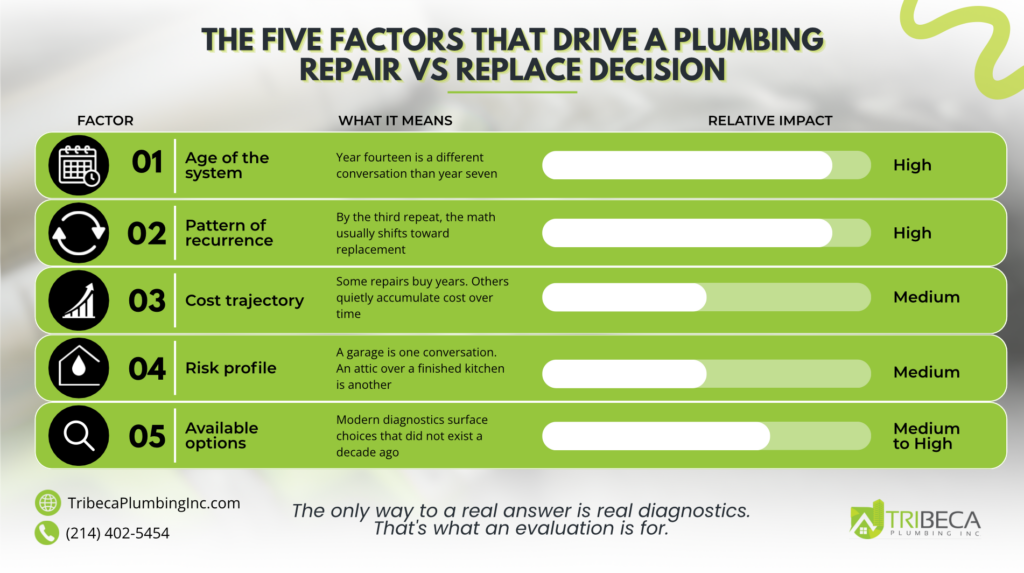
The Five Factors That Drive a Plumbing Repair vs Replace Decision
The honest answer is that the right call almost never comes from a single factor. It comes from weighing five things together, and a licensed plumber doing accurate diagnostics is the person best positioned to weigh them with you.
1. Age of the system relative to its expected service life
A water heater at year fourteen is a different conversation than the same water heater at year seven, even if the symptoms look identical. A cast iron sewer line at sixty years old is in different territory than the same line at thirty. Age shifts the math, and Dallas homes built before 1985 are entering the window where original plumbing systems start aging out at a meaningful rate.
2. Pattern of recurrence
A drain that backs up once, gets cleared, and never backs up again is a different situation than one that backs up every six months. Recurring symptoms almost always point to an underlying condition the surface fix did not address. Repair often makes sense the first time. By the third repeat, the conversation usually shifts toward replacement.
3. Cost trajectory of repair-only
Some repairs are one-time fixes that buy years of reliability. Others are stopgaps that delay the inevitable while quietly accumulating costs over time. A licensed Dallas plumber should be able to tell you honestly which category your specific situation falls into. The math should be visible to you, not hidden inside the recommendation.
4. Risk profile if the system fails
A water heater failure in a garage is inconvenient. A water heater failure in an attic over a finished kitchen is a different category of problem entirely. Slab leaks under load-bearing walls carry different consequences than slab leaks in a guest bathroom. Where a system is and what it sits over should factor into the decision.
5. Available options other than full replacement
Modern plumbing diagnostics often surface options that did not exist a decade ago. Trenchless sewer repair can address conditions that previously required full excavation. Pipe lining can extend the service life of damaged sewer lines without dig-and-replace. Targeted slab leak repairs can solve specific problems without rerouting an entire system. The right diagnosis opens up options. The wrong diagnosis closes them.
Water Heater Repair vs Replacement in Dallas: How to Decide
Water heaters are the single most common repair vs replace conversation we have with Dallas homeowners, and summer is when most of those conversations happen. The decision usually comes down to a few honest questions.
Is the unit eight years old or older?
Tank water heaters in DFW conditions typically last eight to twelve years. Past year eight, the math starts to shift. A repair on a year-six unit usually buys real time. A repair on a year-eleven unit often buys months.
Is the issue at the unit or at the connections?
A leak at the connections is often a straightforward repair. A leak at the tank itself is almost always a replacement signal. Sediment buildup that is causing efficiency loss is sometimes flushable, sometimes not. A licensed plumber should be able to identify which after a real inspection.
Is replacement an opportunity to upgrade to tankless?
If the unit's being replaced anyway, this is the natural moment to consider whether a tankless water heater makes sense for the home. Tankless units last twenty years or longer in DFW conditions, don't store water in attic-installed reservoirs, and don't fight summer heat the same way tank units do. They are not always the right answer for every home, but they're always worth considering at the moment of replacement.
If your water heater is making new sounds, taking longer to recover, or showing any sign of moisture at the base, an evaluation by a licensed Dallas plumber is the right next step. We will tell you which category you are in based on what we actually find.
Sewer Line Repair vs Replacement: When Each One Makes Sense
Sewer line decisions are some of the most consequential plumbing calls a Dallas homeowner makes, and they're also the ones where the decision benefits most from accurate diagnostics.
A sewer camera inspection is the only way to know with confidence what is actually happening inside a sewer line. Without one, repair vs replace conversations are almost always operating on partial information. Anyone recommending sewer line work in Dallas without a camera inspection first is operating on assumption, and assumption is what produces the call-backs we hear about from homeowners who hired the wrong company first.
Here's how the categories typically break down for Dallas sewer lines.
Sewer line repair is usually enough when the issue is localized
A single section of root intrusion. A specific offset where two pipe sections have shifted. A localized blockage caused by buildup or a foreign object. These conditions can almost always be addressed with targeted sewer line repair, hydro-jetting, or trenchless pipe repair without replacing the entire line.
Sewer line replacement starts to make sense when failure is systemic
Multiple sections of damage along the same line. Pipe material that has deteriorated throughout, which is common with cast iron lines past sixty years old in older Dallas neighborhoods like Lakewood, the M Streets, and parts of Highland Park. Repeated backups despite multiple repair attempts. Bellied sections causing flow problems beyond a single point. When the line is failing in multiple places at once, repairing one section while ignoring the others tends to delay the inevitable.
Trenchless sewer repair is often the middle ground
Modern trenchless sewer repair techniques can effectively replace sewer line interiors without digging up yards, driveways, or foundations. For DFW homes with established landscaping or finished hardscaping (common in Preston Hollow, Bluffview, and University Park), trenchless repair is often the difference between an eight thousand dollar repair and a thirty thousand dollar excavation. It is not always the right answer, but it should always be on the table when conditions allow for it.
Slab Leak Repair in Dallas: The Decision That Cannot Wait Long
Slab leaks are the one category in this guide where the wait-and-see option is almost never the right answer.
Dallas homes built on slab foundations have plumbing supply lines running beneath the concrete. When one of those lines develops a leak, water travels through the soil under the slab, sometimes for months, before any visible sign appears inside the home. By the time a homeowner notices, damage is already happening, and continuing to wait extends the damage rather than resolving it.
Slab leak repair decisions in Dallas usually break down this way.
Single-line slab leak repair when the leak is localized
Most slab leaks are a single point of failure on a single supply line. When the location is identifiable through professional leak detection, the repair is often a targeted access through the slab, a section replacement, and a clean repair of the concrete. The home stays largely intact.
Reroute when slab access is impractical
In some cases, the leak location is in a position where a slab access would damage finished flooring, structural elements, or other built-out areas of the home. Rerouting the affected supply line through the attic or walls is sometimes the better option, both for cost and for preserving the home itself.
Repipe when the underlying material is failing
If the slab leak is caused by general deterioration of the original supply lines (common in older Dallas homes with original copper installations), a single repair will buy a limited window before the next leak develops in the same system. A full repipe in PEX or modern copper replaces the failing material, addressing the systemic issue rather than just the visible failure.
The right answer depends on diagnostics. The wrong answer is delay.
What an Honest, Diagnostic-First Plumbing Visit Looks Like
If you've ever had a plumbing visit feel rushed, scripted, or like you were being moved toward a predetermined outcome, you are not imagining it. That experience is genuinely different from how a diagnostic-first plumbing company in Dallas operates.
Here's what an honest visit should look like, from the first phone call to the final recommendation.
The conversation starts with listening
Before any tools come out of the truck, a licensed plumber should ask what you've noticed, how long it has been happening, whether it has come and gone, and what specifically prompted the call today. That information shapes the diagnostic approach. Skipping it's a sign the company is operating from a script rather than from your specific situation.
Diagnostics happen before recommendations
Whether the situation calls for a sewer camera inspection, a leak detection survey, a pressure test, or a system evaluation, the diagnostic step happens first. A recommendation made before the diagnostics are complete is almost always either a guess or a sales script.
Findings get explained in plain language
You should hear what was found, what it means in real terms, and what the options are. If the explanation requires terminology that needs further explaining, that is the licensed professional's job to do, not yours to decode. If you walked away from a previous service call more confused than when it started, that is a signal the company was not built to communicate clearly.
Options get presented without pressure
A real diagnostic visit usually surfaces more than one option. Repair this section. Replace the unit. Reroute the line. Wait and monitor. Each option has tradeoffs, and the licensed plumber should walk through them honestly. The right call usually becomes obvious once the options are clear, and it should not require a hard close from the person doing the work.
The decision belongs to you, made with full information
At the end of an honest visit, you should feel like you understand what is happening with your plumbing system, what the realistic options are, and what each option costs in real terms. The decision belongs to you. The job of the licensed plumber is to make that decision easier, not to make it for you.
Why Summer Is the Right Window for Plumbing Decisions in DFW
There's a practical reason a lot of Dallas homeowners get repair vs replace evaluations done in summer rather than waiting for fall.
Symptoms are visible while the weather cooperates
The same conditions that make summer harder on plumbing systems also make plumbing problems easier to identify. Symptoms that hid all winter become visible. Diagnostics catch things that would not be obvious in February. Catching them now means the decision can be made with full information rather than partial.
Replacement work is faster outside peak emergency seasons
The plumbing industry across DFW gets hit hardest by emergency calls in late summer (when heat finishes off systems already on their last legs) and again in deep winter (during freeze events). Late spring and early summer are calmer scheduling windows. Work that needs to be done can usually be planned rather than reacted to.
You get the full benefit before the next stress season
A water heater replaced in May runs through summer, fall, and the next winter freeze season at full efficiency. A sewer line repaired now is not in the queue with everyone else's emergency call when temperatures swing. The timing math favors planning ahead.
The decision benefits from a calm conversation
Plumbing decisions made under emergency pressure are rarely the best decisions. A repair vs replace conversation that happens before the failure forces it tends to result in better outcomes for the homeowner. Summer is one of the few windows when many of these decisions can be made calmly.
Final Thought: The Plumbing Decision Belongs to You
The reason this guide exists is simple. Most repair vs replace decisions made by Dallas homeowners are made under pressure, with incomplete information, and through conversations with companies whose business model depends on a particular answer.
That is not how the decision should be made, and it's not how Tribeca Plumbing operates.
If something has felt off about your plumbing system, if you've a recurring issue you've been quietly monitoring, or if a system in your home is reaching the age where the question is genuinely on the table, the next step is a real evaluation by a licensed Dallas plumber who will give you full information and let you make the call.
Whenever you are ready, we're here.
Tribeca Plumbing, Inc. | 6211 W Northwest Hwy Ste C251, Dallas, TX 75225 | (214) 402-5454 | tribecaplumbinginc.com | Licensed and insured plumbing, HVAC, and electrical professionals. Open 24/7. Serving Dallas, Highland Park, University Park, Lakewood, Preston Hollow, Plano, Frisco, McKinney, Allen, Richardson, Irving, Carrollton, Garland, Lewisville, Flower Mound, Rockwall, Arlington, Fort Worth, and the broader DFW Metroplex.