Plumbing problems have a way of showing up at the worst possible time — and rarely where you can actually see them.
In Dallas homes, that’s not just a general truth. It’s a structural one. Most DFW properties sit on slab foundations, which means plumbing lines run beneath concrete rather than through accessible crawl spaces. When something starts failing underground or under a slab, the home above it can look completely normal for weeks or months. By the time a symptom surfaces, the underlying condition has often been building for a while.
That gap between what you can see and what’s actually happening is where the right professional makes the biggest difference — and it’s what this guide is designed to help you navigate.
- Common Plumbing and Sewer Problems in Dallas Homes
- Why These Problems Are Common in Dallas Specifically
- Why Plumbing and Sewer Repairs Carry Real Safety Concerns
- What Is a Sewer Camera Inspection — and When Do You Need One?
- Can a Plumbing Problem Be Repaired, or Does It Need to Be Replaced?
- What Professional Plumbing Repair Looks Like at Tribeca
- Why Choosing a Licensed Local Plumber in Dallas Matters
- When Should You Call a Plumber? Signs You Shouldn’t Wait On
- Frequently Asked Questions About Plumbing Repair in Dallas
- Ready for Clear Answers About Your Plumbing?
Common Plumbing and Sewer Problems in Dallas Homes
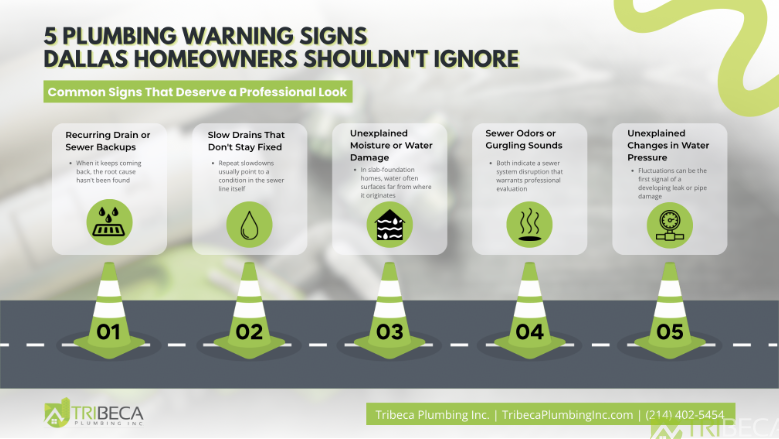
Recurring Drain or Sewer Backups
If a drain backs up once, it may be a simple blockage. If it keeps happening after being cleared, that pattern almost always means the root cause hasn’t been found. Common culprits include root intrusion, pipe deterioration, structural offsets from soil movement, and sewer line conditions that drain cleaning alone can’t resolve.
Slow Drains That Don’t Stay Fixed
A drain that slows down, gets fixed, and slows down again is diagnostic information — not just an inconvenience. Drains that don’t stay clear typically point to a condition in the sewer line itself. A sewer camera inspection is usually the most reliable way to see what’s actually happening.
Unexplained Moisture or Water Damage
Water appearing without an obvious source is one of the more urgent warning signs in a Dallas slab-foundation home. Because plumbing runs beneath the concrete, a slab leak can travel significant distance before surfacing — meaning the location where water appears is often not where the problem originates.
Sewer Odors or Gurgling Sounds
Sewage odors inside a home indicate that gas from the sewer system is entering the living space through a crack, damaged pipe, or blocked vent. Gurgling sounds when water drains point to air displacement somewhere in the line — a blockage, a venting issue, or a structural problem. Both warrant professional evaluation.
Unexplained Changes in Water Pressure
Pressure that drops noticeably, fluctuates between fixtures, or behaves inconsistently can signal a developing leak, pipe corrosion, or early signs of a slab leak — sometimes before any visible water appears.
Why These Problems Are Common in Dallas Specifically
Three factors specific to DFW make plumbing and sewer issues both more likely and harder to detect without professional diagnostics.
Slab foundations mean plumbing runs beneath concrete with no accessible underfloor space. Inspecting or repairing it requires camera diagnostics or excavation — there’s no middle ground.
Aging sewer infrastructure is a reality throughout many established Dallas neighborhoods. Clay tile and cast iron sewer lines — standard in homes built before the 1980s — are prone to root intrusion, cracking, and gradual structural failure. Many are now at or past the end of their expected service life.
Expansive clay soil throughout North Texas shifts with moisture changes — swelling during wet periods, contracting during drought. That cycle exerts ongoing stress on underground pipes, causing joint separation, misalignment, and damage over years of repeated movement.
Why Plumbing and Sewer Repairs Carry Real Safety Concerns
Not every plumbing issue is an emergency — but some categories carry risks that go beyond inconvenience.
Structural and water damage. Water that reaches wood framing, drywall, or the substrate beneath a slab doesn’t just cause surface damage. In Dallas slab-foundation homes, moisture beneath the concrete is largely invisible until it has been present long enough to surface — by which point damage has typically been occurring longer than homeowners realize.
Health risks from sewer exposure. Sewer gas contains compounds that become a health concern at elevated concentrations. Persistent odors mean gas is entering the living space through a failure in the system. Moisture accumulation from slow leaks also creates conditions for mold and bacteria — particularly in enclosed spaces like wall cavities or beneath flooring.
The cost of misdiagnosis. A repair that addresses the visible symptom without identifying the underlying cause buys time — it doesn’t solve the problem. When the issue resurfaces, it’s usually more developed, harder to access, and more expensive to correct than an accurate diagnosis from the start would have been.
What Is a Sewer Camera Inspection — and When Do You Need One?
A sewer camera is a waterproof camera on a flexible cable, fed into the sewer line through a cleanout access point. It transmits real-time video of the pipe’s interior — showing exactly what’s happening without excavation or guesswork.
What a sewer camera inspection reveals:
- Root intrusion into pipe joints
- Cracking, corrosion, or deterioration along the line
- Offsets and bellied sections where the pipe has shifted or sagged
- Blockages and buildup that standard cleaning can’t fully address
- Structural collapse or near-collapse in severely deteriorated lines
When a sewer camera inspection makes sense in Dallas:
- Drain backups or sewer problems keep recurring after being cleared
- The home is older and the sewer line has never been professionally evaluated
- You’re purchasing a home and want to know the condition of the sewer system before closing
- Sewage odors or gurgling drains have appeared without a clear explanation
- A significant repair has been recommended and you want to see what the line actually looks like before deciding
The camera replaces guesswork with documentation. Both the homeowner and the plumber see exactly what the problem looks like — which makes repair decisions clearer and easier to understand on both sides.
Can a Plumbing Problem Be Repaired, or Does It Need to Be Replaced?
This is one of the most common questions homeowners ask — and the honest answer is that it depends entirely on what the actual condition of the system is. No responsible plumber should answer that question before a proper evaluation.
Situations that are often repairable:
- Isolated pipe damage where the surrounding line is in good condition
- Blockages clearable with hydro-jetting or mechanical methods
- Single fixture failures or localized leaks with no systemic involvement
- Sewer damage confined to a short section of otherwise intact pipe
Situations where broader repair or replacement may be the better long-term choice:
- Sewer lines with widespread deterioration or material that has reached end-of-life
- Repeated failures in the same section suggesting a systemic condition
- Structurally compromised pipes that targeted repairs won’t stabilize
What’s found in the evaluation determines what gets recommended — not the other way around.
What Professional Plumbing Repair Looks Like at Tribeca
Evaluation first. A licensed technician takes time to understand what’s been happening — how long, what’s been tried, and what the homeowner has observed.
Diagnostics before recommendations. Appropriate tools are used to assess the actual condition of the system. If a sewer camera inspection is needed, findings are explained clearly before any recommendations are made.
Options presented honestly. Each approach is explained with honest context — what it addresses, what it doesn’t, and what the long-term implications are. No one is asked to approve work they don’t understand.
No sales pressure. Tribeca’s technicians are licensed professionals, not commissioned salespeople. That changes what the interaction is actually about.
Why Choosing a Licensed Local Plumber in Dallas Matters
Dallas homes share specific characteristics — slab foundations, clay soil, aging infrastructure, regional pipe materials — that require familiarity with local conditions to diagnose accurately. A plumber with genuine local experience has seen the failure patterns common to homes of certain ages and construction types. They diagnose faster, more accurately, and with greater accountability.
We serve residential and commercial clients in:
Dallas County:
Dallas, Highland Park, University Park, Irving, Garland, Mesquite, Richardson, Carrollton, Farmers Branch, Addison, Coppell
Collin County:
Plano, Frisco, McKinney, Allen, Prosper, Celina, Wylie, Murphy, Parker, Fairview
Denton County:
Denton, Lewisville, Flower Mound, Highland Village, Corinth, The Colony, Little Elm, Argyle
Tarrant County:
Fort Worth, Arlington, Grapevine, Southlake, Keller, Euless, Bedford, North Richland Hills, Colleyville, Hurst
Rockwall & Kaufman Counties:
Rockwall, Heath, Forney, Terrell, Kaufman
Surrounding Areas:
Las Colinas, Trophy Club, Roanoke, Saginaw, Benbrook, White Settlement, Sachse, Sunnyvale, Balch Springs
Because we operate locally across DFW, we understand the common issues affecting homes and commercial properties in each area — from shifting clay soil in Plano and Frisco to aging sewer systems in Dallas and Irving.
When Should You Call a Plumber? Signs You Shouldn’t Wait On
Call a licensed plumber if you notice:
- A plumbing or sewer problem that keeps coming back after being fixed
- Sewage odors inside the home — at any intensity
- Multiple fixtures draining slowly at the same time
- Gurgling sounds from drains or toilets
- Unexplained wet spots, soft flooring, or moisture on walls or ceilings
- A water bill that’s increased without a change in usage
- Noticeable drops or fluctuations in water pressure
- Any situation where gas line involvement is possible
Most plumbing and sewer conditions don’t resolve on their own. Root intrusion keeps growing. Pipe deterioration continues. Acting on early warning signs is almost always the lower-risk, lower-cost choice.
And you don’t need to know exactly what’s wrong before calling. The first conversation is often just that — describing what’s been happening and when. That’s enough to determine whether an evaluation makes sense.
Frequently Asked Questions About Plumbing Repair in Dallas
Ready for Clear Answers About Your Plumbing?
If you’re dealing with a recurring issue, unexplained symptoms, or simply want a professional evaluation before something becomes urgent — the right next step is an accurate assessment by a licensed professional who will tell you exactly what’s happening and what your real options are.
At Tribeca Plumbing Inc., we start with diagnostics. We explain what we find, what it means, and what makes sense — so you can decide with confidence, not pressure.
- Schedule a sewer camera inspection or plumbing evaluation — see the problem instead of guessing
- Speak with a licensed plumber, not a salesperson — get honest answers based on what’s actually there
- Get recommendations built around what solves the problem long-term
Visit TribecaPlumbingInc.com to learn more about plumbing and sewer services in Dallas, TX.
Call Tribeca Plumbing Inc. at (214) 402-5454 to speak with a real professional today.
Serving residential and commercial clients across Dallas and the DFW Metroplex — including Plano, Richardson, Irving, Garland, Frisco, and surrounding DFW communities.
Tribeca Plumbing Inc. — licensed professionals, accurate diagnostics, real solutions.